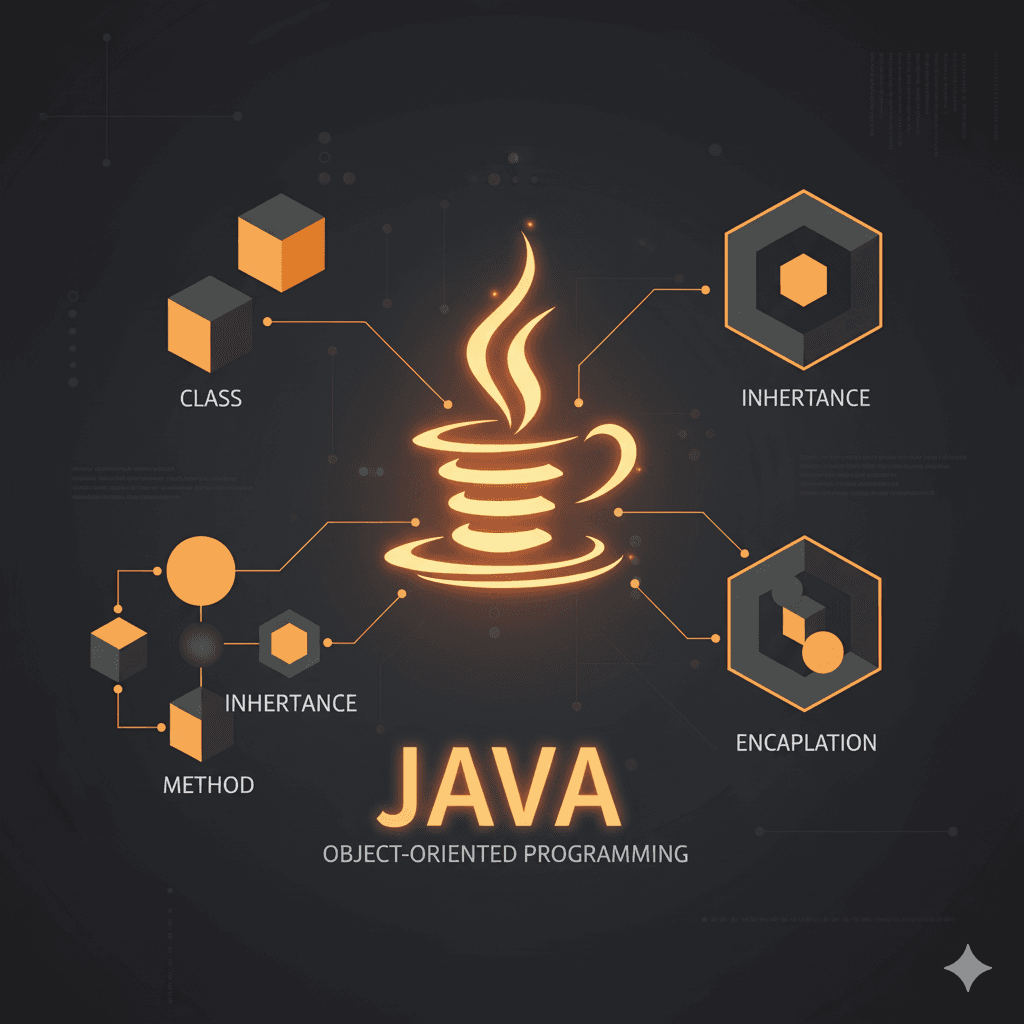
Java Programming for Beginners
A strong introduction to Java, focusing on core OOP principles and industry-standard practices.
This course covers the fundamentals of Java, the most widely used enterprise programming language. You'll master Object-Oriented Programming (OOP) and build small, functional console applications.
Master Java syntax, data types, and control flow.
Apply core OOP principles: Encapsulation, Inheritance, Polymorphism.
Handle exceptions and file I/O in Java.
Build a fully functional command-line application.
Meet Your Mentors

Yamlak N.
Java Instructor
Expert in modern web frameworks and best practices.
Detailed Course Curriculum
Java Environment, Variables & Operators
Setup JDK/IDE. Introduction, Variables, Data Types, Operators, and Input/Scanners.
Control Flow: Conditionals
Conditions, Booleans, IF/ELSE, ELSE IF, and Nested Statements.
Control Flow: Loops & Arrays
For Loops, While Loops, and basic Array handling.
Collections I: Lists and Sets
Introduction to Collections, Sets and Lists.
Collections II: Maps & HashMaps
In-depth work with Maps, HashMaps, and examples.
Introduction to Objects
Creating Classes, objects, and the 'new' keyword.
Core OOP: Classes & Encapsulation
Creating Classes, defining methods, and access modifiers. Inheritance.
Inheritance & Static Keyword
Extending classes, the 'super' keyword, and static members.
Advanced OOP: Interfaces, Enums, & Inner Classes
Abstract classes, Interfaces, Enum types, and Inner Classes.
Polymorphism & Overloading
Method Overloading and dynamic method dispatch.
Exception Handling
Try-catch-finally blocks and custom exceptions.
File Input/Output (I/O)
Reading from and writing to files.
Mini Project: Calculator App
Build a fully functional command-line calculator app.
Code Review & Refactoring
Reviewing project structure and applying best practices.
Final Project Presentation
Showcase the Calculator and handle Q&A.
Testing & Debugging Basics
Using the IDE debugger and writing basic JUnit tests.